You agreed to play tennis this Saturday morning with your two closest friends. You’re a little nervous because it’s been a while since you lasted played and they’re regulars at the courts, so you decide to arrive a little early to warm up.
Besides shaking the dust and rust off your racket, taking the time to warm up is a fantastic idea for multiple reasons!
While our muscles have the great ability to respond to changes in length and tension, they can get cold—both figuratively and literally speaking—if we’ve been sedentary, slow moving, or in a chilly environment whether for hours, days, weeks, or months.
Strains, sprains, and painfully sore muscles can be unfortunate causes of unprepared physical activity, especially for those with bone and joint conditions such as osteoarthritis or rheumatoid arthritis.
Researchers have found that stretching before exercise has the following positive effects:
Interestingly, however, not all stretches are equal…especially when it comes to the type of exercise you plan on performing afterwards.
Static stretching is what most people think of when they hear "stretch."
It’s the holding of a position that elongates a specific muscle or muscle group for at least 20 seconds.
Usually static stretches are in a seated or standing position, but the key is that you remain stationary (or static) throughout the duration of the stretch.
For example, the man below is targeting his left calf muscle by keeping his heel as close to the ground as he can while lunging forward. His calf muscle (scientifically called the gastrocnemius), receives the benefits of this stretch by being elongated for a period of time.
This form of stretching is becoming more and more popular—especially for athletes before a practice or competition.
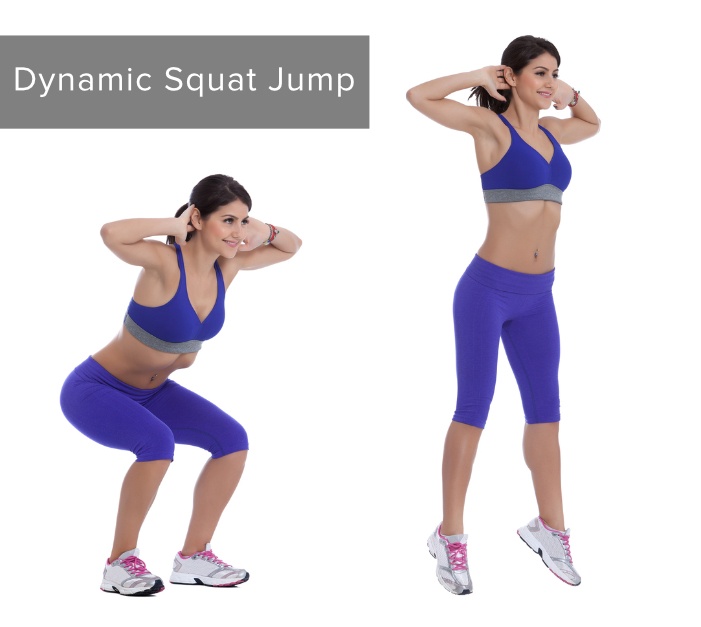
Dynamic stretching is an active method of warming up. Instead of holding a stretch at the end of its range (like in static stretching), dynamic stretches are full movements that typically mimic the those that will be performed during the game or workout.
One example is performing types of jumping or hopping patterns, like the woman below doing squat jumps. Performing repetitions of dynamic movements in conjunction with other active stretches, can warm up your upper and lower legs before an activity that involves jumping—like volleyball or basketball.
It depends.
We know, that’s not a satisfying nor definitive answer…but we can give you some scenarios in which researchers have found one to be more effective than the other.
Our bodies don’t like to be thrown into intense or explosive activity. Unlike sports cars, we can’t go from zero to 60 mph in a few seconds.
Depending on the kind of physical activity you’re going to be doing and what your goal is, you’ll want to consider the type of warm up you’ll do beforehand, whether it’s a dynamic stretching routine, a series of static stretches, or both!